

Never Walk Alone: How to Navigate Chaos at a Peruvian Football Game

In order to achieve your goals in Peru you need to go with the flow, often literally. Nothing will teach you that better than going to a football game. It’s something I learned upfront, personally, and gloriously.
It was February 2022, a mere couple of weeks after I had moved to Lima on a wild swing at happiness and with no more than a dozen Duolingo lessons’ worth of Spanish.
With three more games to play in the Eliminatorias, the South American qualifiers for the World Cup, Peru still had a shot to make it to the tournament in Qatar later that year. The stakes were high, and miraculously I had managed to get one of the sought-after tickets online, hardly understanding what the website said.
That day, I was meeting my new friend Rafaella, who had offered to take me to the stadium. “You’ll need help, man.”
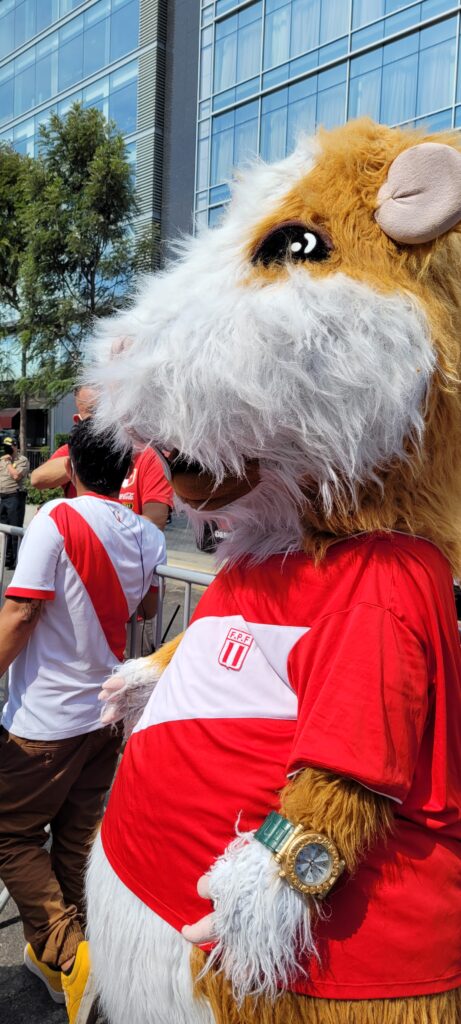
But just as I was about to arrive at her place in Miraflores, I ran into a partying mob and a gigantic guinea pig. The Peruvian team was staying at a hotel around the block, and its mascot, a guinea pig imaginatively called “El Cuy” (“The Guinea Pig”) was pushing the crowd outside into a red-and-white-hot frenzy.
Moving through the masses, I made it to Rafa’s place eventually, to be greeted with the question of whether I had been a good citizen and printed out my digital ticket. Of course I hadn’t, who’d think of that, and off we were, a solid three or so hours before kickoff, first to one of the many copy shops nearby, still a massive thing in Peru, then to the stadium.
We were going to ride on the notoriously overpacked Metropolitano, the city’s main public traffic artery, but of course, you needed coins to get your ticket, no way around it, only one way through it: by buying a snack at some shop nearby and praying they’d give you change.
Prayers answered, and a few breathless bus stops later, we were making our final steps to the stadium on foot. Lima’s Estadio Nacional is located in a residential neighborhood in the city center, and the streets up to a kilometer from the stadium were already crowded with vendors, parrillas (barbecues) sizzling from anticuchos (skewers of cows’ or bulls’ hearts), and countless people offering the invaluable service of printing out your digital ticket for you. If you know, you know.
We had just wrestled ourselves through to the correct gate, when the past hour’s relentless hustle and bustle suddenly felt like a walk in the park. City police on horseback somehow thought going right through the crowd was a great way to get things in order, and when the guards at the gate were clearly having none of that, they just closed it – while people were still entering.
I was ready to give up and watch the game on television, but life in Lima clearly had taught Rafaella the way to go: “Just keep pushing ahead, and don’t stop.” Same as the guards, basically, who wouldn’t let up. We just squeezed by the closing gate door, and we were inside.
Only one of us had an actual ticket, though.
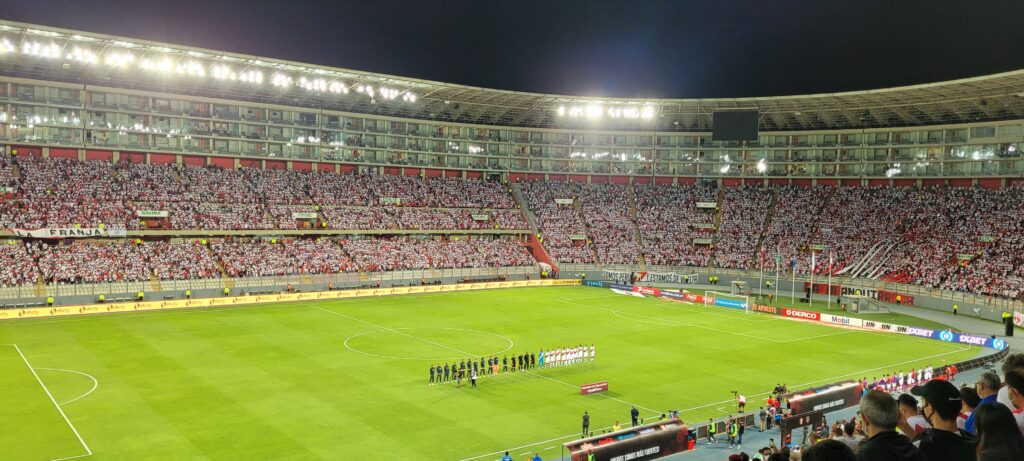
But Rafa was done with the shenanigans for the day and happy to head home, and I had a game to watch for which I had certainly paid too much, including with my health. It ended 1-1, and while I remember the crowd going absolutely plátanos (well, bananas) when Edison “Orejas” Flores scored the equalizer in minute 69, my memories of everything around and before the game are much stronger.
They were more consequential, too. Peru finished fifth in the Eliminatorias (by the one point they won that day), only to be eliminated in a penalty shootout during the Inter-confederation play-offs against Australia, thus failing to make it to the World Cup. I have a rechargeable card for the Metropolitano now, pushed and pushed to be able to live in Lima, and Rafa remains a close friend.
We have yet to attend a game together.